What Is the Toughest Division in the UFC in 2026? Welterweight Feels Hardest, but Elo Crowns Lightweight
Welterweight looks like the most dangerous division in the UFC: the line of contenders behind Islam Makhachev is frightening just to read. Our Elo ratings, however, crown lightweight. Here is what the numbers say about Makhachev, Topuria, Du Plessis and the rest of the elite.
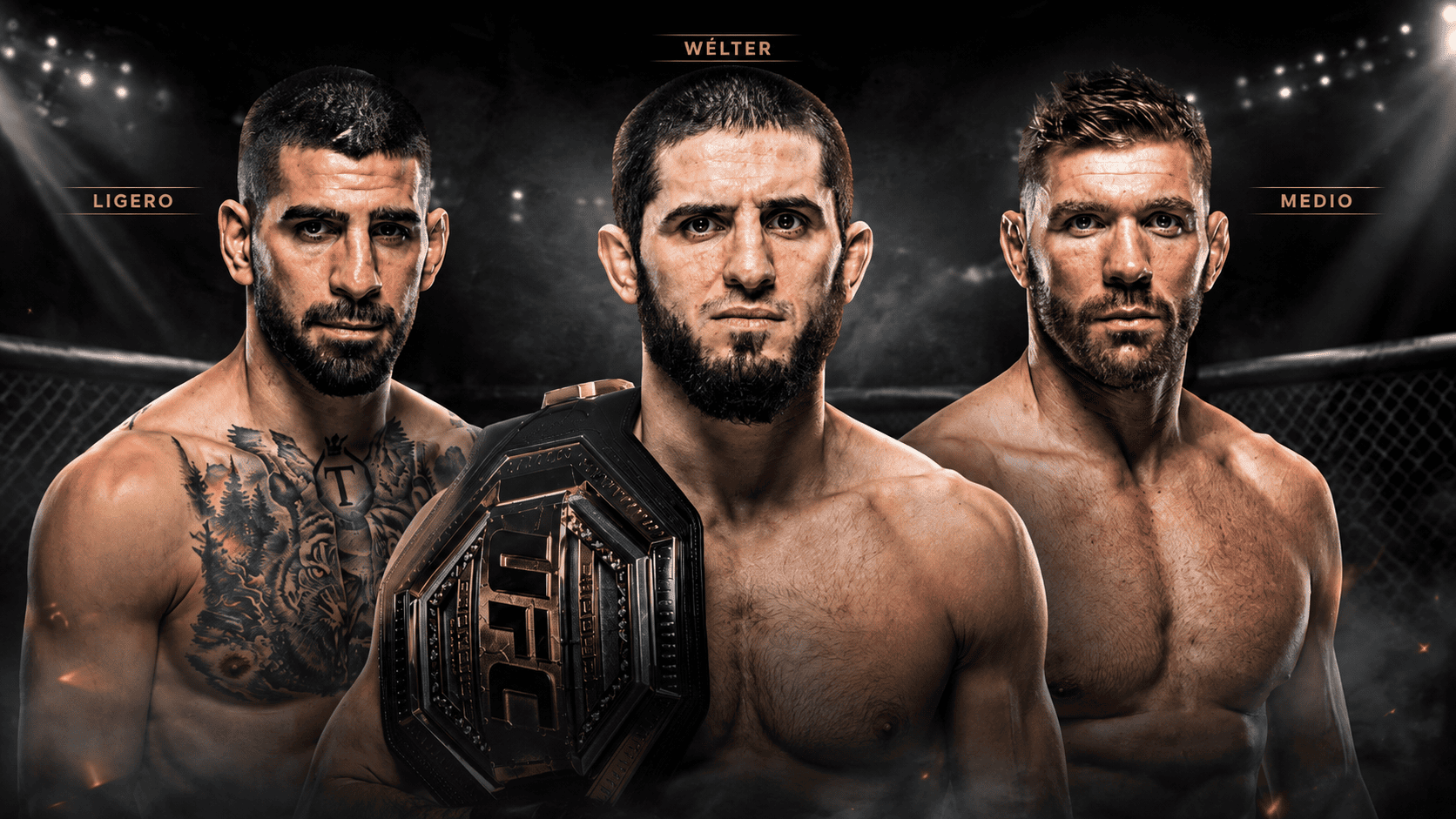
Ask any fan which UFC division is the hardest right now and there is a good chance they will say welterweight. The champion, Islam Makhachev, has a line of contenders behind him that is frightening just to read, and it feels as if any of them could beat him on a bad night. It is a reasonable instinct. According to our Elo ratings, it is also an incomplete one.
When we rank the active fighters in the UFC's eight men's divisions by their current Elo rating, the top spot does not go to welterweight. It goes to lightweight. Middleweight sits right behind in second, and welterweight completes the podium. Before explaining why, it is worth being clear: this is not a flaw in our system or a quirk that needs fixing. It is the answer to a slightly different question from the one we usually argue about on social media.
This analysis reflects our ratings as of early August 2026.
Two different questions, two different answers
When we say a division "is the toughest," we are almost always thinking about the road to the title: how many real contenders there are right now and how close they are to each other. Our Elo measures something a little broader: the accumulated quality of a division's entire elite, from number one to number twenty-five. Both views are legitimate, and in the case of welterweight, lightweight and middleweight they tell stories that complement each other more than it first appears.
Putting the numbers in context
Before going further, a quick reference for reading the numbers ahead. On our scale, 1500 is the usual starting point for any UFC fighter. From there, 1700–1799 marks an established career; 1800–1999 is the competitive and contender elite; 2000–2199 is proven elite territory; 2200–2399 means title dominance, built on long streaks and repeated defenses; and 2400 and above is historic dominance, the level of the sport's legends. With that in mind, a rating like Makhachev's 2492 is not just a high number: it reaches into the territory reserved for the greatest careers in UFC history. If you want to explore it at your own pace, our visual guide to the Elo scale shows active fighters in every band.
Why welterweight feels impossible
Let's start where fans start. Makhachev brought all the competitive value he had built over his career up to welterweight, and his rating of 2492 was the highest of any active UFC fighter, ahead even of names like Alex Pereira and Alexander Volkanovski. He is, by a distance, the highest-rated fighter in our entire database.
What stands out is not just how far above everyone Makhachev is, but how tightly packed the rest are. Right below the champion, almost on top of each other, sit Ian Machado Garry (1930), Carlos Prates (1913), Michael Morales (1860), Belal Muhammad (1856), Sean Brady (1852), Jack Della Maddalena (1850) and Leon Edwards (1838). Take Makhachev out of the equation and those seven names fall within a window of just 92 points. In practice, that means any of them can beat any other on a Saturday night, and our system confirms it number by number.
That is what makes welterweight feel like the most dangerous division in the UFC: not one fearsome opponent, but an entire line of them, separated by details.
Lightweight wins because it has a mountain range, not a single peak
Lightweight reaches the top for a different reason. Instead of a dominant champion followed by a tight pack, it has five fighters who would be the undisputed number one in almost any other division: Ilia Topuria (2205), champion Justin Gaethje (2119), Charles Oliveira (2106), Max Holloway (2058) and Arman Tsarukyan (1973).
Topuria staying above the champion himself is not a whim of the system. Gaethje won their most recent meeting, in June 2026, but Topuria had arrived at that fight after a run of title wins by stoppage over historic opponents: he knocked out Volkanovski, Holloway and Oliveira, all three of them champions or former champions at the time. Gaethje, meanwhile, built his current reign with ups and downs: he lost three title fights along the way (to Khabib, Oliveira and Holloway) before winning the belt. The result is that Topuria has built a cushion of points that not even the loss to the champion has fully erased.
And it is not just a range of contenders: it is a range of former champions. Topuria was undisputed featherweight champion before moving up to lightweight and taking the belt from Oliveira, who had himself held it in two separate stages of his career. Holloway, for his part, had an equally long reign at featherweight. No other men's division gathers so much championship pedigree around its reigning champion.
The number that best sums up this division is that Topuria, without being champion, has the fourth-highest rating among all active UFC fighters, behind only Makhachev, Volkanovski and Pereira. Four names on that list are above 2000, and no other division has so many fighters that high at the same time. That is why lightweight wins in our standings: not because welterweight is weak, but because lightweight has more stars at their peak simultaneously. Volume helps too: 87 active fighters, the largest roster of the three divisions in this debate.
Middleweight, the surprise almost nobody mentions
If the debate were only lightweight against welterweight, we would be leaving something important out. Middleweight sits just a handful of points behind lightweight in our overall standings, and it hides one of the most striking facts of the whole cutoff: Dricus Du Plessis (2088) is rated higher than the champion himself, Sean Strickland (2030). This is no accident either: Du Plessis won both of their title fights, in January 2024 and February 2025, and has three title wins to Strickland's two. His rating also got a recent boost when, no longer champion, he beat a Kamaru Usman who came into that fight with a very high rating. Right behind them, Khamzat Chimaev (2021) and Kamaru Usman (1970) complete a quartet that has nothing to envy the other two divisions.
Of the three, middleweight also has the most fighters rated above 1800: twelve. Neither lightweight (eight) nor welterweight (eleven) reaches that figure. It is a division that does not shout as loudly as welterweight or shine as brightly as lightweight at the very top, but fighter for fighter it holds up better than it usually gets credit for.
So which one is the toughest?
The honest answer is that it depends on what you are measuring. If the question is which division has the tightest race to the title right now, welterweight has the best case: a champion off the charts and a pack of contenders that are almost impossible to separate. If the question is which division has the most top-level talent at the same time, including several former champions, lightweight wins, narrowly, thanks to a summit with five generational names. And if anyone tells you middleweight does not measure up, show them Du Plessis's rating.
In our points standings, lightweight came first, middleweight just 2 points behind and welterweight third, a little over 8 points off the lead. In practice it is a three-way tie that the next event can reshuffle without warning. UFC 330, where Makhachev defended the welterweight title against Machado Garry on August 15, 2026, was exactly the kind of fight that can move this conversation. Makhachev won by decision.
If you want to see it fighter by fighter, explore the True Contender MMA complete UFC rankings and check for yourself what builds each number.
Sources
Comments
Loading comments...