Abdul Rakhman Yakhyaev Fights the Way We All Imagine Fighting in Our Dreams
Abdul Rakhman Yakhyaev has needed just 3:33 to collect three finishes in the UFC. We look at what they reveal, the questions that remain and how far he can go.
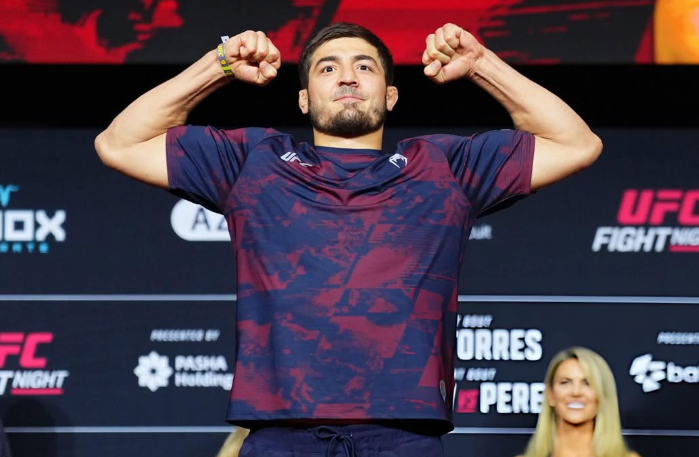
The bell rings and Abdul Rakhman Yakhyaev does not give up a single second to negotiate what kind of fight it will be.
He moves forward. He throws a spinning wheel kick that partly lands on Raffael Cerqueira and, before the Brazilian can reset his guard, he is already on him with his hands. The punches force him back. Then comes the head kick. Cerqueira drops next to the fence and tries to get up, but Yakhyaev does not stop to admire the damage: he chases him, gets into his hips and takes him back down.
There is no pause between one phase and the next. Striking, takedown, control. Cerqueira tries to stand and gives up his back. Yakhyaev slides his arm under the chin even before fully securing his hooks, locks in the rear-naked choke, adjusts a body triangle and squeezes. Cerqueira taps.
Thirty-three seconds have passed.
In that span, Yakhyaev landed six significant strikes, scored a knockdown, completed a takedown and logged 24 seconds of control. More than a fight, it looks like the fantasy we have all had at some point: stepping into a cage, attacking without fear and finding that every technique leads perfectly into the next. Nothing fails. Nothing jams. The opponent can only react while we do exactly what we had imagined.
But this article is not about 33 seconds. It is about finding out how long that fantasy can last when Abdul Rakhman Yakhyaev starts meeting opponents capable of putting up more resistance.
Who is Abdul Rakhman Yakhyaev
Yakhyaev was born in Chechnya, represents Turkey and has built an international training base. He usually works with MMA Nürnberg in Germany and has also trained at Fight Sports Deerfield Beach in Florida under Gesias "JZ" Cavalcante. He stands 6-foot-2 with a 78-inch reach, fights out of an orthodox stance and turned 25 in January 2026.
His competitive background explains how naturally he connects the different areas of a fight. He is a Master of Sport in combat sambo and MMA, as well as a NAGA European grappling champion. Before turning professional he worked as a plumber and earned a university degree in banking, two details that humanize a competitor whose presence in the cage seems anything but ordinary. His official UFC profile also explains the origin of his nickname, "The Hunter": he likes taking belts from champions.
He turned pro in 2021 with ACA Young Eagles. He won his first fights by ground and pound, triangle and another TKO before going five rounds with the then-unbeaten Nikolay Kovalenko to win the KhanFight light heavyweight title by decision. It remains the only decision win of his career.
Then came Ares FC. In July 2024 he submitted Paulin Begai with a guillotine to win the vacant belt and, two months later, defended the title by finishing Jacky Jeanne with a rear-naked choke. His run on Dana White's Contender Series was even shorter: a right hand sent Alik Lorenz backward, Yakhyaev chased him to the fence and finished the fight with strikes in just 30 seconds.
He arrived in the UFC as a regional champion, unbeaten and with a pattern that could no longer be called coincidence. He now holds a 10-0 record: four wins by KO/TKO, five by submission and one by decision. Eight of his wins ended in the first round.
Three fights, three different messages
Yakhyaev's three UFC wins add up to just three minutes and 33 seconds. The number is spectacular, but it is more useful to separate the fights and look at what each one reveals.
Raffael Cerqueira: the ability to compress a fight
The win over Cerqueira, on November 22, 2025, was the purest expression of his style. There was no gradual reading process. Yakhyaev opened with a high-risk technique, forced his opponent back, produced the knockdown, turned the damage into a takedown and used the attempt to stand up to take the back.
The sequence was violent, but not chaotic. Every action closed a possible exit and opened the next one. That is the most valuable thing about the performance: Yakhyaev is not just fast or aggressive. He has a rare instinct for recognizing when an opponent has gone from defending a technique to surviving the whole sequence.
The rear-naked choke at 33 seconds set the record for the fastest submission in UFC light heavyweight history. The official statistics confirm the scale of the domination: Cerqueira did not land a single significant strike.
Brendson Ribeiro: adapting when the plan stops being perfect
The second fight was far more informative.
Brendson Ribeiro landed a left hand as Yakhyaev came forward, stuffed a first takedown attempt and later found a clean head kick. For the first time in the UFC, the prospect had to absorb strikes, rethink the distance and solve a problem that did not disappear just by speeding up.
His response was smart. He caught Ribeiro's head kick, took him down and started working from top position. When the Brazilian threatened a kimura, Yakhyaev blocked the attack, moved to control his hips and began a chain of lifts and returns to the mat. Ribeiro managed to get to his feet, but not to separate. Yakhyaev kept the pressure on, got a hook in, landed short strikes and waited for the neck to appear.
The rear-naked choke came at 2:52 of the first round. The UFC's official report highlighted exactly that patience after an uncomfortable start.
Cerqueira showed what happens when Yakhyaev takes control immediately. Ribeiro showed something more important for projecting his future: he can take in unpleasant information, switch tools and keep making good decisions.
Julius Walker: no takedown needed when the right hand does the job
The third win dismantled the idea that everything depends on taking the opponent down.
Julius Walker came forward ready to trade. Yakhyaev threw his first strike, a compact overhand right, and dropped him. He followed him down with more punches and the referee stopped the fight at eight seconds.
It was the second-fastest knockout in UFC light heavyweight history, tied with James Irvin's and behind only the seven seconds Ryan Jimmo needed against Anthony Perosh. The official UFC Baku recap notes that Walker went down from the first strike Yakhyaev threw.
The finish matters because his takedown threat shapes his opponents' stance. Yakhyaev changes levels quickly, forces their hands down and can turn that expectation into an overhand right. He does not need every opponent to fear his boxing in isolation; he needs them to fear the punch, the level change and the chase that follows, all at once.
Yakhyaev's real style
True Contender MMA classifies him as a fighter with three very clear trademarks: constant pressure that forces opponents to fight going backward, knockout power capable of ending a fight in any exchange, and a permanent submission threat when the fight hits the mat. His three badges, Pressure Fighter, KO Artist and Submission Specialist, accurately reflect the aggressive, versatile style he has shown in his UFC performances.
His best quality is not a specific technique but continuity. Some fighters strike and then look for the takedown. Yakhyaev strikes while building the takedown; he takes opponents down already anticipating how they will try to get up; he controls the back, using ground and pound to open the submission. The opponent never gets a clear moment to recognize that one phase has ended.
He also has a very valuable physical combination at 205 pounds: the speed of a lighter fighter with enough strength to lift, return to the mat and control big men. His entries from range are explosive, and his pressure forces opponents to work before they have found their rhythm.
The third strength is psychological. Yakhyaev fights with a confidence that does not seem manufactured for the cameras. He throws committed techniques from the start, chases damage without becoming completely disorganized and accepts exchanges because he knows he can turn any contact into another phase of the fight. That confidence explains why his opponents seem to be reacting from the very first second.
The questions that still have no answer
The excitement is justified. The certainties are not there yet.
The Ribeiro fight showed the first potential crack. Yakhyaev can come in upright and exposed as he closes the distance. The Brazilian found him with a hook, stopped his first takedown and landed a head kick. Against Ribeiro he could absorb those shots and turn the second kick into a takedown; against a more accurate striker or an opponent with better wrestling defense, the same kind of entry could cost him much more.
We also do not know how his pressure works after ten minutes. The five-round decision over Kovalenko shows he has gone 25 minutes, which is a positive, but it happened in January 2023 against regional opposition. Nobody in the UFC has forced him to wrestle tired, work off his back or rebuild his offense after losing a round.
His current percentages should be read with great caution. The UFC shows a 100% takedown defense, but his opponents have barely had time to try to take him down. Likewise, his averages for strikes, takedowns and submissions are distorted by a sample of three minutes and 33 seconds. They describe the violence of his wins; they do not guarantee he can reproduce it over three or five rounds.
The big exam will be finding out what is left when an opponent survives the first attack, shuts down the first wrestling chain and manages to make him fight going backward.
Quality of opposition: the necessary limit on the excitement
The three finishes are genuinely extraordinary. The opposition, however, demands caution before extrapolating.
Cerqueira came in 0-3 in the UFC. Ribeiro was 2-4 in the organization. Walker had a 1-2 record. Together, the three had a combined 3-9 UFC record before facing Yakhyaev.
Cerqueira had suffered two losses by strikes and was close to being released. Ribeiro was dangerous because of his power and his submissions, but had shown very vulnerable takedown defense. Walker was younger and more athletic than the other two, although he was coming off the first knockout loss of his career, against Dustin Jacoby.
That does not invalidate the way Yakhyaev beat them. Many prospects get accessible opponents and do not produce a comparable showing. Finishing three light heavyweights in a row in 3:33 requires real skill. What it rules out is the logical jump from "exceptional prospect" to "proven future champion."
Yakhyaev has passed every test he has been given. He simply has not been given a top-level test yet.
His ceiling and his place at light heavyweight
His ceiling is that of a serious contender. Talking about a champion would be premature, but writing him off as a product of matchmaking would ignore too many signs.
He is 25, has regional championship experience, tools to finish both standing and on the ground, and a transition game that usually translates to the elite better than isolated power does. He also competes in a division where the average age of the established names is still high.
At the time of writing, the landscape offered an opportunity, but also a considerable leap. Carlos Ulberg held the championship, with Alex Pereira, Magomed Ankalaev and Jiří Procházka still near the top. At the same time, Navajo Stirling has already broken into the rankings, and prospects like Iwo Baraniewski form, along with Yakhyaev, a generation capable of renewing the division.
Yakhyaev was not yet in the official top 15 when this analysis was written. His next fight should start answering questions instead of producing another replay. He needs an opponent capable of defending chained takedowns, keeping composure under pressure and punishing him on the way in. A veteran sitting between the bottom of the rankings and the front line of the unranked would provide much more information than another specialist who is vulnerable in his weakest area.
If he gets through that kind of fight, his rise could be fast. At 205 pounds, three or four convincing wins usually separate anonymity from a title eliminator.
True Contender MMA's Elo rating
As of August 4, 2026, the True Contender MMA system gave Abdul Rakhman Yakhyaev 1656.54 Elo points, enough for 20th place among 41 active light heavyweights.
His progression within the model has been steady:
- 1555.02 after finishing Cerqueira.
- 1608.82 after submitting Ribeiro.
- 1656.54 after knocking out Walker.
That figure placed him just below Dustin Jacoby (1659.39) and above Nikita Krylov (1645.89), while Iwo Baraniewski sat slightly higher at 1668. You can follow his progression on Yakhyaev's profile and compare it with the complete light heavyweight rankings.
The most important reading is that the model shares the excitement, but does not yet turn it into a proven contender. His rating remains in the "starting and developing" band, between 1500 and 1699. He is less than 44 points away from the established-fighter level, but Elo rewards accumulated evidence, not visual impressions or imagined potential.
The finishes accelerated his progression because the True Contender model values the method of victory, the opponent's level and the gap between the expected and the actual result. The quality of the opposition, at the same time, keeps three spectacular wins from artificially catapulting him toward the elite.
That is probably the most honest assessment of Abdul Rakhman Yakhyaev right now: he already fights like a man capable of going very far, but his résumé has not caught up with his highlight reel.
His next fight should change that. If he repeats his dominance against an established opponent, he will cross a line we have so far only been able to imagine. If he meets resistance, we will learn something even more valuable: whether the fighter of our dreams also knows how to win when the fight stops looking like a dream.
Comments
Loading comments...