Which Country Has the Best UFC Fighters in 2026? The US, Brazil and Russia Head to Head
The United States wins on depth, Russia packs in more elite talent and Brazil is right on both their heels. We compared 533 active fighters with our own cutoff, updated through August 8, 2026.
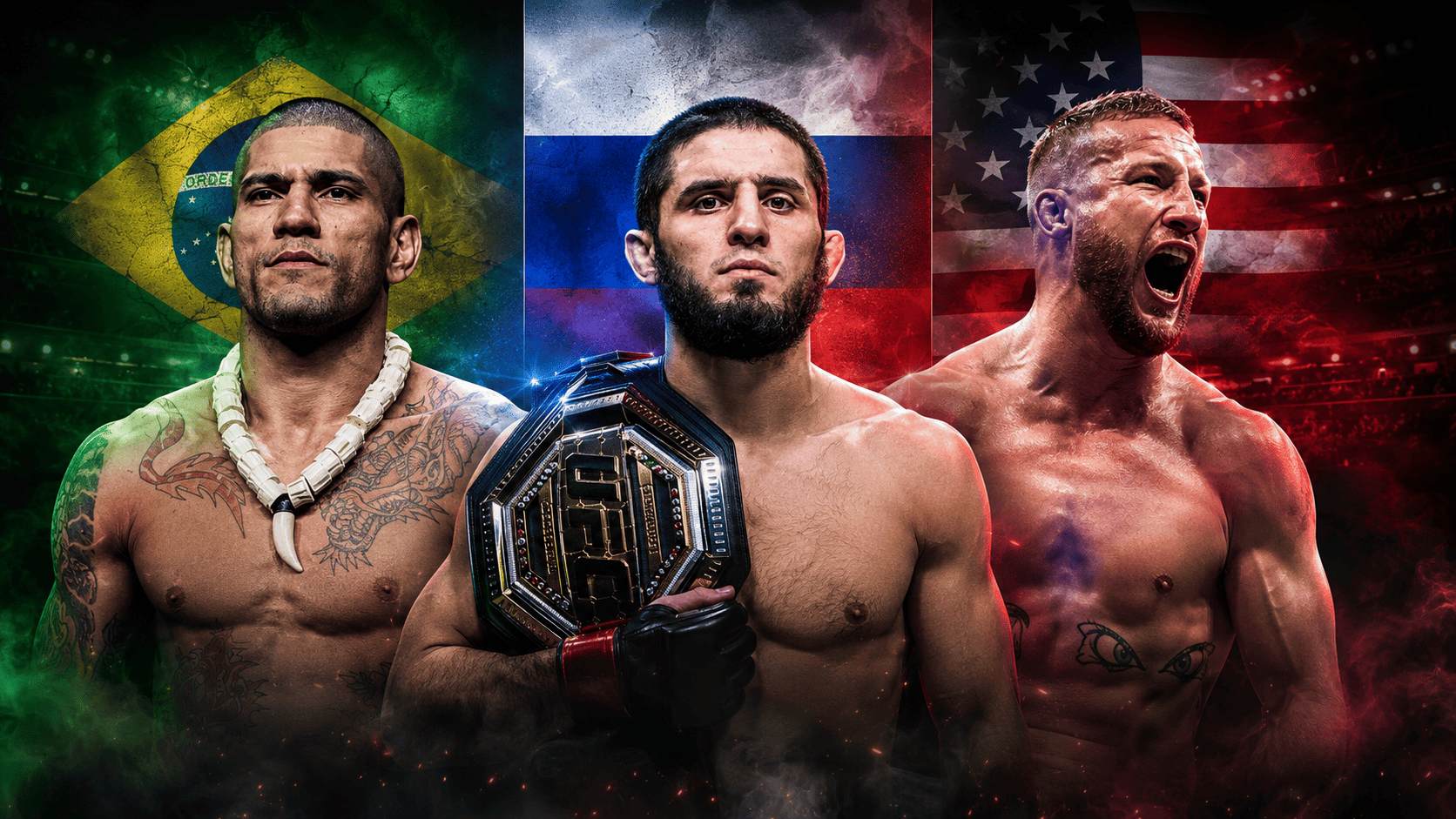
When someone asks which country has the best UFC fighters, they are almost always mixing three different questions: who supplies the most names, who concentrates the most elite talent, and who keeps up the level once you get past their two or three stars.
The UFC feeds that debate with content grouped by nationality, and its official Record Book lets you filter fighters by country. We have added a layer that is missing from the conversation: comparing the active men's roster on the same Elo scale, with an explicit cutoff date.
How to read the Elo numbers in this article
Our Elo rating summarizes each fighter's accumulated competitive value based on their results, opponent quality, the type of win and the significance of the fight. To interpret the figures below, we use these rough bands:
- 1500–1699 · Starting and developing: the usual starting point, debutants and fighters still building a solid sample.
- 1700–1799 · Established fighter: a proven UFC record and the ability to compete with established opponents.
- 1800–1999 · Competitive and contender elite: contenders, former champions and other top-level fighters.
- 2000–2199 · Proven elite: the level associated with recent champions and former champions still competing at the top.
- 2200–2399 · Title dominance: an exceptional rating built on title defenses, long streaks and repeated wins over the best opposition.
- 2400 and above · Historic dominance: territory reserved for long reigns or extraordinary competitive peaks.
These bands help place each rating, but they are not official categories or win probabilities. You can find the full explanation in our guide to what UFC Elo ratings mean.
The short answer: it depends on what "best" means
According to our data, the United States has the deepest group, Russia the highest concentration of elite talent, and Brazil the most solid balance between volume and quality. None of those statements contradicts the others: each one answers a different metric.
- United States: 181 active fighters, 36 rated at least 1700 and 13 rated at least 1800.
- Russia: 25 active fighters; its top five average 2087.4 Elo and seven are above 1800.
- Brazil: 78 active fighters; its top five average 2043.6 and its top ten 1934.1.
In our view, if "best country" means assembling the most complete national team without relying on one star, the United States comes first. If the question rewards how much elite talent each roster spot produces, Russia moves to the front.
Three ways to measure a country's strength in the UFC
1. Roster depth
The United States supplies 181 of the 533 active fighters in our cutoff: 34.0%. Brazil has 78, or 14.6%, and Russia 25, or 4.7%. The difference in scale is huge, and it explains why simply counting names, without measuring quality, favors the UFC's home country so heavily.
As an outside data point, the UFC itself described the United States in April 2026 as the most represented country on its roster and Brazil as the second, with roughly half as many athletes. Our independent count keeps the same order, although it uses its own definition of an active fighter and only the eight men's divisions we model.
2. Number of elite fighters
Across our entire roster there are 62 fighters rated 1800 or higher. The United States has 13, Brazil 11 and Russia seven. Lower the bar to 1700 and the figures become 36, 20 and 11.
The absolute count favors the United States again, but the proportion changes the story: 7.2% of the US roster is above 1800, compared with 14.1% of Brazil's and 28.0% of Russia's. That difference is the strongest evidence for Russian efficiency.
3. Top-five and top-ten averages
Russia leads the top five with 2087.4 Elo. Brazil follows with 2043.6 and the United States with 2038.2. Widen the sample to ten fighters, though, and the United States climbs to first with 1952.8, while Brazil sits at 1934.1 and Russia at 1933.9.
The inference is clear: Russia's peak is the highest, but the advantage fades once you demand a second line. Brazil and Russia are separated by just 0.2 points in the top ten, a gap far too small to support any real superiority between them on that measure.
The United States wins when the comparison demands depth
Justin Gaethje (2119), Max Holloway (2058), Sean Strickland (2030), Aljamain Sterling (2029) and Sean O'Malley (1955) make up the American top five. None of them reaches the individual peak of Islam Makhachev or Alex Pereira, but the group stays above 1950 from top to bottom.
The advantage shows most clearly behind those names. The United States places 12 fighters among the top 50 ratings on the whole roster and 26 among the top 100. Brazil has seven and 17; Russia, seven and nine. That continuity covers more divisions and absorbs a loss or a retirement better.
You can see the full order in our ranking of fighters from the United States.
Russia produces the most concentrated elite
Islam Makhachev (2492), Petr Yan (2147), Magomed Ankalaev (2001), Alexander Volkov (1901) and Movsar Evloev (1896) lift the Russian top five to 2087.4. Makhachev has the highest individual rating of the three countries and opens a gap no other national leader comes close to.
Russia does not depend on him alone, though. Even from sixth to tenth there are Umar Nurmagomedov (1877), Sergei Pavlovich (1843), Azamat Murzakanov (1735), Ikram Aliskerov (1729) and Shara Magomedov (1718). Eleven of its 25 fighters are above 1700.
Our reading is not that every Russian fighter is better than their American or Brazilian counterpart. It is that, within the roster we rank, Russia turns a much smaller base into an extraordinarily high share of competitive names.
The details are in our ranking of fighters from Russia.
Brazil is the most balanced rival
Alex Pereira (2217), Charles Oliveira (2106), Alexandre Pantoja (2072), Carlos Prates (1913) and Diego Lopes (1910) put Brazil above the United States in the top-five average. Its front line features elite names spread across five divisions.
Brazil also holds up when the sample grows: 11 fighters above 1800 and 20 above 1700. Its top-ten average of 1934.1 is 18.7 points behind the United States and two-tenths of a point ahead of Russia.
That is why we consider it the most balanced of the three. It has neither the American volume nor the Russian concentration, but it gets close to both extremes without relying on a single favorable metric.
You can browse all 78 names in our ranking of fighters from Brazil.
Our verdict
- Best complete roster: the United States, for its depth and for leading the top-ten average.
- Highest concentration of elite talent: Russia, for its top five and the share of fighters above 1800.
- Best balance between volume and quality: Brazil, very close to Russia's top ten and with more than three times the depth.
If we have to pick a single winner for the general question, we choose the United States. It is a conclusion based on the breadth of the roster, not a universal truth: a criterion that rewards efficiency per fighter would put Russia first, and one that values balance would leave Brazil a whisker behind.
How to explore the rankings by country
Our directory of UFC rankings by country lets you open each national group, see all of its active fighters and click through to their individual profiles. It is not limited to an official top 15: the current cutoff ranks 533 names from 73 countries.
To interpret the ratings and their ranges, see our guide to what UFC Elo ratings mean.
Methodology and cutoff date
We consulted our rankings on August 10, 2026. The dataset contains 533 active fighters across the eight men's divisions modeled by True Contender and includes results processed through August 8, 2026.
We ranked fighters by their current Elo rating. For each country we measured roster size, the number of fighters above 1700 and 1800, the top-five average and the top-ten average. The thresholds are not official UFC categories; they are descriptive cutoffs applied identically to every country.
Elo values results, opponent quality, type of win and competitive significance under a common rule. It is not a vote, a betting line or a guaranteed probability of winning.
We assigned each fighter to the country code shown on their True Contender profile. We did not group Russia with other former Soviet republics, nor did we combine countries by region, ethnicity, training location or gym.
Limitations
- The women's divisions are not included because they were not yet part of our internal model at this cutoff, so this article does not measure the entire UFC roster.
- A sporting nationality does not necessarily reflect dual citizenship, place of residence, cultural identity or the country where the fighter developed their career.
- Averages favor or penalize countries differently depending on roster size, which is why we show depth, elite talent and concentration separately.
- The cutoff is a snapshot from August 10, 2026. A single championship fight can visibly move a country's top five.
- The analysis measures current level as represented by Elo, not each nation's historical importance in MMA.
Sources and data consulted
Comments
Loading comments...